Feeds:
Posts
Comments

A

A

“Don’t let your mouth write a check that your tail can’t cash.”

A

–Bo Diddley

A

~*~

a

Bo Diddley had an enormous impact on the development of popular music, largely due to his emphasis on rhythmic elements.

Bo Diddley had an enormous impact on the development of popular music, largely due to his emphasis on rhythmic elements.

A

“I opened the door for a whole lot of people– and they just ran through and left me holding the knob.”

A

–Bo Diddley

A

Bo Diddley in action on his signature Gretsch guitar --late 1950s.

Bo Diddley in action on his signature Gretsch guitar --late 1950s.

A

“I thank you in advance for the great round of applause I’m about to get.”

A

–Bo Diddley

A

Bo Diddley on guitar with Jerome Green on the left playing maracas  --late 1950s,

Bo Diddley on guitar with Jerome Green on the left playing maracas --late 1950s.

A

“I made Bo Diddley in ‘55, and everybody freaked out.  Caucasian kids threw Beethoven in the garbage can.”

A

–Bo Diddley

A

Bo Diddley and his signature gretsch guitar --late 1950s.

Bo Diddley and his signature Gretsch guitar --late 1950s.

A

A

 Jerome Green in the center, Bo Diddley on the rear of the scooter --1959.

Jerome Green in the center, Bo Diddley on the rear of the scooter --1959.

A

A

Norma-Jean "The Duchess" Wofford in white blouse, Jerome Green squatting in front with maraca, and Bo Diddley with his signature Gretsch guitar --late 1950s.

Norma-Jean "The Duchess" Wofford in white blouse, Jerome Green squatting in front with maraca, and Bo Diddley with his signature Gretsch guitar --late 1950s.

A

A

Bo Diddley on a Gretsch guitar --late 1950s.

Bo Diddley on a Gretsch guitar --late 1950s.

“New Yorkers love it when you spill your guts out there.  Spill your guts at Wimbledon and they make you stop and clean it up.”

–Jimmy Connors

~*~


Mr. A. F. Wilding, Wimbledon Champion.

Mr. A. F. Wilding, Wimbledon Champion.

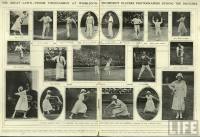
SOME COMPETITORS IN THE ALL-ENGLAND LAWN TENNIS CHAMPIONSHIPS AT WIMBLEDON.

SOME COMPETITORS IN THE ALL-ENGLAND LAWN TENNIS CHAMPIONSHIPS AT WIMBLEDON.

THE WORLD'S RACKET CARNIVAL.  Leading British, Colonial, and foreign aspirants to championship honours in this week's great gathering at Wimbledon.

THE WORLD'S RACKET CARNIVAL. Leading British, Colonial, and foreign aspirants to championship honours in this week's great gathering at Wimbledon.

WEARERS OF THE LAWN-TENNIS BLUE RIBANDS: WIMBLEDON FINALISTS.  Rene Lacoste, top right.

WEARERS OF THE LAWN-TENNIS BLUE RIBANDS: WIMBLEDON FINALISTS. Rene Lacoste, top right.

THE GREAT LAWN-TENNIS TOURNAMENT AT WIMBLEDON: PROMINENT PLAYERS PHOTOGRAPHED DURING THE MATCHES.

THE GREAT LAWN-TENNIS TOURNAMENT AT WIMBLEDON: PROMINENT PLAYERS PHOTOGRAPHED DURING THE MATCHES.

THE KING: WIMBLEDON INAUGURATED: FAMOUS PLAYERS.  Mlle. Suzanne Lenglen, top right.

THE KING: WIMBLEDON INAUGURATED: FAMOUS PLAYERS. Mlle. Suzanne Lenglen, top right.

QUEENS OF THE TOURNAMENT: FAMOUS LAWN-TENNIS PLAYERS; WIMBLEDON.

QUEENS OF THE TOURNAMENT: FAMOUS LAWN-TENNIS PLAYERS; WIMBLEDON.


Max Bubeck sitting on his 135.58mph hybrid Indian Chief/Scout that he rode at Rosamond Dry Lake on June 27th, 1948.  The Pop Shunk-built "Chout" is as lean and mean as a straight razor except for two big-assed carburetors that look big enough to pluck poultry. Bubeck's "Chout" still holds the record for the world's fastest unfaired Indian motorcycle.

Max Bubeck sitting on his 135.58mph hybrid Indian Chief/Scout that he rode at Rosamond Dry Lake on June 27th, 1948. The Pop Shunk-built "Chout" is as lean and mean as a straight razor except for two big-assed carburetors that look big enough to pluck poultry. Bubeck's "Chout" still holds the record for the world's fastest unfaired Indian motorcycle.


“Mad Max” Bubeck made a name for himself dominating the enduro scene from the 1930s to the 1970s.  Bubeck was also a speed racer & builder who in June of 1948 rode his Indian “Chout” (an Indian Chief 80 c.i. engine jammed into the smaller & lighter Scout frame) to a record speed of 135.58 mph on the Rosamond Dry Lake north of Los Angeles. It’s a record that still stands for an unstreamlined, normally aspirated 80 cubic inch displacement Indian motorycle.  After retiring from competition in the late-1970s, Bubeck continued to be active in motorcycling, doing everything from restoring classic Indian motorcycles to sponsoring antique motorcycle meetings.


Mad Max Bubeck on his famous & record setting Indian "Chout".

Mad Max Bubeck on his famous & record setting Indian "Chout".


One of Bubeck’s most popular wins came in 1950 aboard the new Indian Warrior. That year, he won the Cactus Derby, a long-distance desert race and mountain race originated in Riverside, California. The race was unique in that it started at midnight. That year, Bubeck’s bike lost its lighting barely an hour into the race. He managed to continue by riding with other riders and using their lights. A few times he lost touch with the other riders and rode in complete darkness. In that same event, a long, slow-moving freight train was blocking a crossing. Bubeck sped ahead of the train and crossed the tracks so as to not lose too much time. Despite the darkness, the trains and riding a supposedly uncompetitive bike, Bubeck still managed to win the event. It went down as one of the most memorable victories in his career.


Mad Max" Bubeck on his record-setting hybrid Indian "Chout".

Mad Max" Bubeck on his record-setting hybrid Indian "Chout".


Being born in the LA area was a very fortunate happening for me. By 1933 at age 15, I already had my first motorcycle, a 1930 101 Scout. It wasn’t long before I got acquainted with the local “hounds,” as we were known then, and every week end we would be off to some event, usually a TT race, field event, or beer bust.

One of the favorite spots was about 15 miles east of LA at Sam Parriots’ in Puente Ranch. The LA 45 Club put on steak feeds and field meets at least twice a year and one of the big attractions was a straight, blacktop road that ran for a mile, then made a dogleg turn to the right, then left and up a hill. This was known as the Puente Strip.

By 1937, we would convene our motorcycles in “drag outs” or speed runs at least once a month on early Saturday mornings before there was any traffic. By 1939, Frank Christian had built an electric-eye timing clock so we could get accurate times. This was a great help to the local racers and speed-trialers to check their machines for performance. It was in October of 1941 and I left home early Saturday morning on my ‘39 Indian Four, headed for Puente. The route was east on Valley Blvd to Fifth Street, in Puente, a right turn across some railroad tracks, then a left turn onto the strip.

As I came around the corner at about 30mph, I saw three machines just starting on a run. The one on the left was Ed Kretz on his #38 Sport Scout race bike, and the others were a couple of Harleys. I thought, why not see if I could catch them, so I pulled the Four back into second gear and got on it. I was gaining on all three, and soon passed the Harleys but Kretz was still ahead. I was slightly to the left of him and my front wheel was along side his rear wheel, both of us still in second at 75mph. Ed looked over his right shoulder, saw the Harleys behind him, snapped into high gear and laid down on the Scout. I did the same on my Four and the Scout started to pull away at 90mph. So I edged into his draft about three feet behind and managed to stay there at over 100mph. The immediate reaction after clearing the timing traps was to sit up and get on the brakes because that dogleg was pretty sharp at that speed.

So Kretz did the usual and turned around to see how far ahead he was of the Harleys. I still laugh when I think of the look on his face when he saw me three feet behind him! His eyes bugged out and almost pushed his goggles off! As we slowed, I came alongside of him and he said, :Where did you come from?” I said, “I was there all the time.” My speedometer stop-hand read 114mph and when we got back to the timer, we found out we had hit 112.50mph.

I later took the Four through at 108.43mph, without the benefit of the draft—this was just as I rode it on the streets—headlights, fenders, saddlebags, the works. Sam Parriot tried to talk me into talking off the extra garbage and trying again, but I was happy with that speed. Remember—this was 1941, when few machines would clock an honest 100mph.

Kretz asked me to take his Scout through and see what I could get out of it, as I was about 40 pounds lighter. It clocked exactly 112.50mph with me on it, too. This was the week before the big 200 mile race at Oakland. Kretz had the best qualifying time at 94mph on the very rough one mile track, paved with a low bank on the turns. Kretz, of course, had the pole and at the end of the first lap had a 200 foot lead, which kept increasing every lap until he lapped the second-place rider on the 32nd lap.

Soon after that, there was a very bad accident in the south turn, which resulted in two deaths and several others taken out of the race. How Ed didn’t go down is a miracle of some sort. Movies taken of the accident make you shake your head in wonder that Kretz didn’t end up in the pile of motorcycles sliding into the fence. Later, when asked how he got through, Ed said he closed his eyes and held on. Anyway, Ed managed to get through the mess without going down and lead until the 117th lap, when his front chain broke and put him out of the race. Front chains weren’t supposed to break on Indians with the oil bath but his did. I guess Indian must’ve gotten a batch of bad chains, improperly heat-treated.

Those were great days! As well as riding my ‘39 Four on the streets and on trips, I also rode the Four in cross-country events like the Greenhorn 500-miler. I had the privilege of travelling with Ed Kretz, and sometimes Jimmy Kelly another good Indian rider. We usually piled into the car late on Saturday, and drove long, hard, and late at night to make some Sunday racemeet at some distance from LA. Many were the pranks and jokes. The world was our playground and we would never grow old.

–Max Bubeck as told to Jerry Hatfield in 2000.


“The harder the conflict, the more glorious the triumph.”


–Thomas Paine


~*~


1966 Triumph motorcycle ad

1966 Triumph motorcycle ad


Vintage Triumph motorcycle ad

Vintage Triumph motorcycle ad


Vintage Triumph motorcycle ad

Vintage Triumph motorcycle ad


Vintage Triumph Motorcycle ad

Vintage 1977 Triumph Bonneville motorcycle ad


Los Angeles is 72 suburbs in search of a city”

–Dorothy Parker


~*~


Ed Holovchik [aka Ed Fury], bodybuilder and Mr. Los Angeles contestant with model Jackie Coey-- 1953.

Ed Holovchik (aka Ed Fury), bodybuilder and Mr. Los Angeles contestant with model Jackie Coey --1953.


Ringling Bros. and Barnum & Bailey Circus clowns Coco and Bobby Kaye visiting a patient at Los Angeles Orthopedic Hospital --1970.

VISITING TRIO-- Ringling Bros. and Barnum & Bailey Circus clowns Coco and Bobby Kaye visiting a patient at Los Angeles Orthopaedic Hospital --1970.


FOOD'S FUN-- Nancy Kennedy, 20, downs diet cola and french fries, popular combination with the young set. The theory is that diet drink saves enough calories to allow for the fattening french fries.  L.A. Times --1965.

FOOD'S FUN-- Nancy Kennedy, 20, downs diet cola and french fries, popular combination with the young set. The theory is that diet drink saves enough calories to allow for the fattening french fries. L.A. Times --1965.


Comedian Eddie Cantor with beauty contestants Lisa Davis, Barbara Drake and Phyllis Applegate, Los Angeles, CA --circa 1954.

Comedian Eddie Cantor with beauty contestants Lisa Davis, Barbara Drake and Phyllis Applegate, Los Angeles, CA --circa 1954.


Marilyn Monroe and Jane Russell putting handprints in cement at Chinese Theater in Los Angeles, CA  --circa 1953.

Marilyn Monroe and Jane Russell putting handprints in cement at Chinese Theater in Los Angeles, CA --circa 1953.


PERFECTION?-James L. Pyle and Nonna Walls examine "Miss Formula", a computer-created drawing resulting from a list of "perfect female" statistics, CA 1964.

PERFECTION?-James L. Pyle and Nonna Walls examine "Miss Formula", a computer-created drawing resulting from a list of "perfect female" statistics, CA 1964.


Pat Hall, "Miss 7-Cent Cup of Coffee, 1950," serving William E. Kinman coffee while wearing a bikini, Los Angeles, CA  --1950.

Pat Hall, "Miss 7-Cent Cup of Coffee, 1950," serving William E. Kinman coffee while wearing a bikini, Los Angeles, CA --1950.


Man wearing gag thumb with three bathing beauties, Long Beach, CA  --1949.  Someone please explain...

Man wearing gag thumb with three bathing beauties, Long Beach, CA --1949. Someone please explain...


PRECAUTIONARY MEASURE-Policeman Chuck Peyton checks to see if the old-fashioned bathing suit worn by actress Myrna Ross complies with 1933 Redondo Beach ordinance banning women's suits that are more than 3 in. above knee. The city attorney warned enforcement may be necessary if topless suits appear on beaches. Male swimmers would also be required to wear more discreet attire.

PRECAUTIONARY MEASURE-Policeman Chuck Peyton checks to see if the old-fashioned bathing suit worn by actress Myrna Ross complies with 1933 Redondo Beach ordinance banning women's suits that are more than 3 in. above knee. The city attorney warned enforcement may be necessary if topless suits appear on beaches. Male swimmers would also be required to wear more discreet attire.


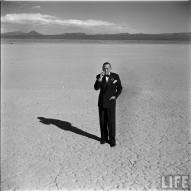
Rollie Free made made history aboard a 1948 Vincent HRD V-Twin motorcycle, often referred to as the “Bathing Suit Bike” due to the scant attire of its rider, Roland “Rollie” Free.  John Edgar hired Free to make the attempt at the Bonneville Salt Flats on Sept. 13, 1948. Free initially removed the bike seat and laid flat out on his stomach to minimize wind resistance, and when the stitching on his leathers failed and they began flapping in the breeze, he discarded them too, opting instead for a simple pair of tight bathing trunks, a swim cap, and a pair of tennis shoes. Tragedy could have been the result, but Free averaged a smoldering 150.313 mph, smashing the previous American speed record and establishing a new world record for unstreamlined and unsupercharged bikes.


~*~


Roland Free breaking world's speed record on Bonneville Salt Flats while laying on his bike  --September, 1948.

Roland Free breaking world's speed record on Bonneville Salt Flats while laying on his bike --September, 1948.


Roland Free breaking world's speed record on Bonneville Salt Flats --September, 1948.

Roland Free breaking world's speed record on Bonneville Salt Flats --September, 1948.


Roland Free breaking world's speed record on Bonneville Salt Flats while photographers try to snap pictures  --September, 1948.

Roland Free breaking world's speed record on Bonneville Salt Flats while photographers try to snap pictures --September, 1948.


Roland Free chatting with photographer at Bonneville Salt Flat --September, 1948.

Roland Free chatting with photographer at Bonneville Salt Flat --September, 1948.


Cycleworld


Fashion is treated too much as news rather than what it is, what it does and how it performs.”
 

–Geoffrey Beene


~*~


Gentle reminder that clothes do not make the man.  --Esquire magazine.

Gentle reminder that clothes do not make the man. --Esquire magazine


One of our pet peeves has always been the type of fashion copy that endeavoured to implant the sweet notion that “dressing the part” would put you over to tumultuous applause, regardless of your natural qualifications. We become slightly ill every time we read about dandy underwear that will automatically take so many strokes off your golf score. Of course, come to think of it, nobody has tried to sell the undergraduate on a good appearance as a magical aid to success in the classroom– perhaps because that’s the last brand of success that he’ll worry about, or perhaps because he doesn’t need selling on the value of good appearance anyway. By and large, and with particular reference to any eastern universities, he’s as clothes conscious as the sex can present. Current manifestations of this tendency are found in the popularity of the Glen Urquhart suit in a saxony fabric which resembles flannel in its softness and ease of drape but outdistances it in wearing qualities. This example, in a soft red two button model, carries a bold red overplaid. The white oxford button down collar attached shirt, always a favourite shirt of the college man is the round collar attached model, in oxford, Scotch cheviot, chambrays and broadcloths-the collar fastened with a gold safety pin. Wool socks are a year round standby of the undergraduate and although the colors and patterns will vary from season to season, the weight remains pretty much the same, being on the light side rather than the heavy. The bold Argyle plaids, on white grounds, are especially popular. 


What?  Garters on a page of college fashions?  Yes, sir!

What? Garters on a page of college fashions? Yes, sir! --Esquire magazine


Our scouts have been infesting fraternity houses, dorms and locker rooms for months and now they arise, to a man, and declare that undergraduates do wear garters. Perhaps, after all that has been said and written on the subject, that’s an item for Ripley. Anyway, we just know they wear ‘em– the solid color elastic web kind, sketched here. As for other things they’re wearing, the trend at the moment seems to be toward an elaborately casual English countryside manner. The balmaccan topcoat is a case in point. So, for that matter, is the extent to which they are wearing short sleeveless sweaters. This is a direct follow-up on the lead of young Englishmen, a recent report from London saying that there the bright young men are turning up at smart cocktail parties wearing these short sleeveless sweaters with light weight tweed suits. As for color combinations, since men have definitely thrown off the feminine-fostered taboo against the use of grey and brown in combination, many odd color schemes have won acceptance. The big surprise, of course, is how quickly the black banded brown hat has caught on as a college and prep school fashion, to say nothing of the extent to which it has won acceptance among men of the sportsman type. Brown brogue shoes are getting a big play on the campus from those very undergraduates who, for a long time, stuck to the white buckskin shoe for year around wear. Knitted ties are the dominant note as far as neckwear is concerned, although the batwing bow, as shown on the next page, is gaining ground fast. The hat in the panel is the Tyrollean type for sportswear, an item that is getting acceptance at the Eastern colleges. 


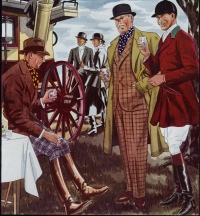
Safely out of town your colour choices can run very wild.  --Esquire magazine.

Safely out of town your colour choices can run very wild. --Esquire magazine


At the best hunt race meetings you will see the boldest colours and patterns. Keep your eyes off the picture for a minute, and see if this doesn’t sound godawful: green suit, blue and white striped shirt, plaid tie that is predominately red, reddish brown shoes and tannish brown hat, and gray topcoat. Put them all together and they spell hash, but put them on a man who has any flair at all for wearing clothes, and they add up to make a strikingly effective outfit that is beyond reproach from a fashion standpoint. The suit is a single breasted easy fitting Harris tweed, the shirt is of heavy cheviot with a rounded soft collar attached, the tie is woolen, of deep maroon with a gray overplaid, the shoes are buckskin ankle high and closely akin to jodhpur shoes in cut. The allover stitched tweed hat is a sportsman’s favourite at the moment. The other outfit, a bit more seemly if the schedule should include a return to town for cocktails, is comprised of a rough finish bowler, a three button notched lapel suit of gray cheviot with a pronounced blue overplaid, a solid coloured shirt of light weight flannel, a black tie with bold blue stripe, black brogues, and a tan covert topcoat, The umbrella handle, though you can’t see it, is leather and has a gold pencil inserted at the crook. The latter is one of the fearfully swank British touches, but it seems to be catching on and is therefore worthy of mention. The dark vertical streak in the southwest corner of the jacket shown on the left is not to be interpreted as an overemphasised shadow. It represents one of a pair of side vents-much better in coats intended for town wear, than the usual single centre vent. Note the four buttons at the cuff. 


The black Homberg-- the hero swipes the villain's hat. --Esquire magazine

The black Homberg-- the hero swipes the villain's hat. --Esquire magazine


In the gallery of stock types, the black hat has always indicated one of three characters– the clergyman, the politician, or the villain in the play. The latter connotation will have to be repealed now, however, as the black Homburg hat has now settled down as an established fashion in this country, on the heads of the smartest young-men-about-town and juniors of Wall Street, after having enjoyed a run of about a year in London before gaining acceptance on this side. With it, as demonstrated by the figure in the foreground, you would wear about the same kind of outfit that would normally go with this hat model in any other color. The coat, for example, is a gray double breasted Shetland– a cloth that is highly prized by the knowing for its softness and fine draping quality. This topcoat is noteworthy for its comparative shortness and for its tendency to flare. The suit is of a fine blue-gray worsted and with it go black straight tipped shoes and a blue and white striped soft shirt worn with a round starched collar, The tie is black foulard– another fashion by Wall Street out of London– with purple polka dots. Also of traceable English origin is the custom, now being taken up rapidly in this country, of wearing a deep red carnation with business clothes as well as when dressed for evening. In keeping with this outfit’s general tendency to swank is the use, as a final fitting note, of yellow chamois gloves. Another good outfit, by the way, is that combination shown in the background– a fly front covert topcoat with ticket pocket at the waist line, worn with a lightweight bowler hat. This can be worn with rough tweedy suitings. This mixing up of town and country fashions is currently sanctioned.


“I still get goose pimples.”  –Steve McQueen


~*~


sports illustrated steve mcqueen page1    

sports illustrated steve mcqueen page2 

sports illustrated steve mcquen page3 

sports illustrated steve mcqueen page4 

sports illustrated steve mcqueen page5 

sports illustrated steve mcqueen page6 

sports ilustrated steve mcqueen page7 

sports illustrated steve mcqueen page8 

sports illustrated steve mcqueen page9    

via Steve McQueen Online

“Racing is life. Anything before or after is just waiting.”  –Steve McQueen


~*~


Steve McQueen hopping in his Jaguar XKSS-- 1963.

Steve McQueen hopping in his Jaguar XKSS-- 1963.


Steve McQueen tinkering between shooting scenes for Wanted dead or Alive.

Steve McQueen tinkering between shooting scenes for Wanted dead or Alive.


Steve McQueen showing director John Sturges his Jaguar XKSS on the MGM studio lot.

Steve McQueen showing director John Sturges his Jaguar XKSS on the MGM studio lot.


Steve McQueen 


Jaguar XKSS Steve McQueen


steve mcqueen 


Steve McQueen Jaguar


Steve McQueen's Jaguar XKSS & Lotus 11

Steve McQueen's Jaguar XKSS & Lotus 11


Steve McQueen Lotus 11


Steve McQueen Jaguar

Steve McQueen in his AC Cobra-- 1963.


Carroll Shelby, Steve McQueen and the equally legendary Cobra.

Carroll Shelby, Steve McQueen and the equally legendary Cobra that Shelby lent him.


McQueen’s Machines


“The American South is a geographical entity, a historical fact, a place in the imagination, and the homeland for an array of Americans who consider themeselves southerners. The region is often shrouded in romance and myth, but its realities are as intriguing, as intricate, as its legends.”

–Bill Ferris

~*~

vintage Southern menswear style

Original caption-- An old "African-American" man wearing a disheveled outfit, with one arm akimbo & the other propping him up with a stick, casually standing in small Southern town-- 1938.


antique vintage church sign

Continue Reading »

Older Posts »